
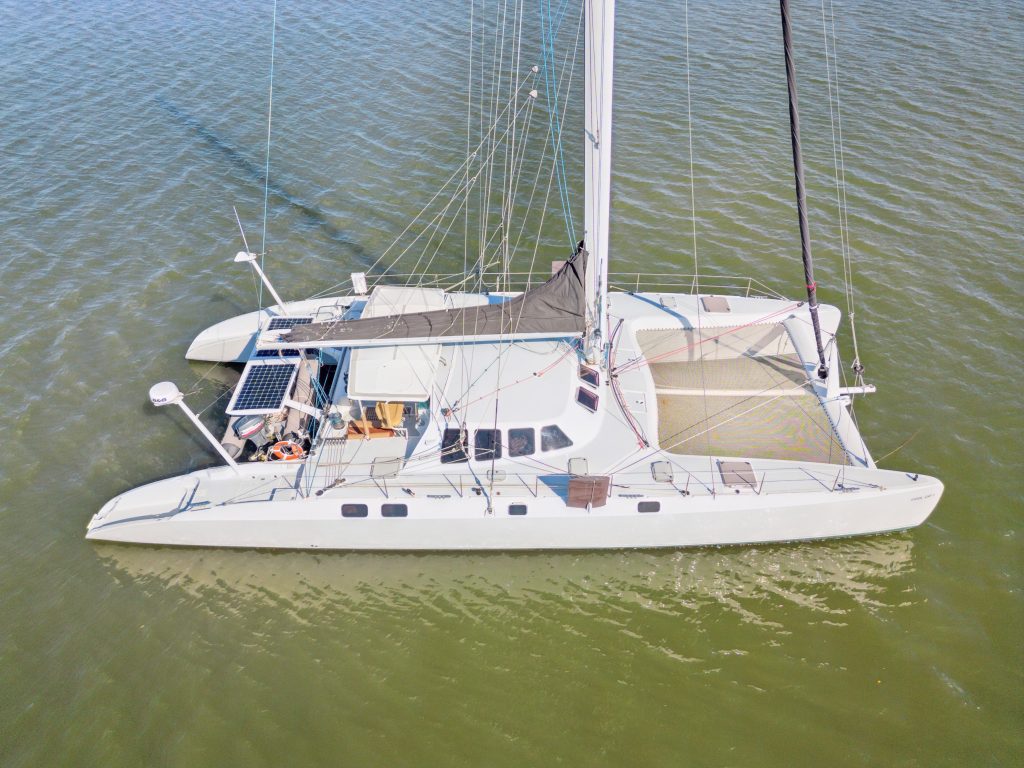
Hull number three of six sisters from Brazil's Technologie Marine, built light, rigged in carbon and proven on ocean passages.

Some catamarans are apartments that happen to float. S/V Cool Cat, a Technologie Marine Entincelle 60 lying in Sarasota, Florida, is emphatically not one of them. In this walkthrough, broker Alexis de Boucaud steps aboard a carbon performance catamaran built with a single obsession: keeping weight down and speed up.
From the helm
The tour begins at the raised helm station, where the view runs forward over the two bows, the sail plan and the mast, and aft over both sterns — excellent visibility of the whole boat from one seat. The position sits close to the crew in the cockpit and saloon, and features a two-person helm seat with brand new B&G instruments including a 12-inch plotter, radar, speed and depth, plus a Standard Horizon VHF remote. The cockpit Bimini has a canvas opening so you can stand in fair weather and stay under cover in foul.
Carbon from keel to masthead
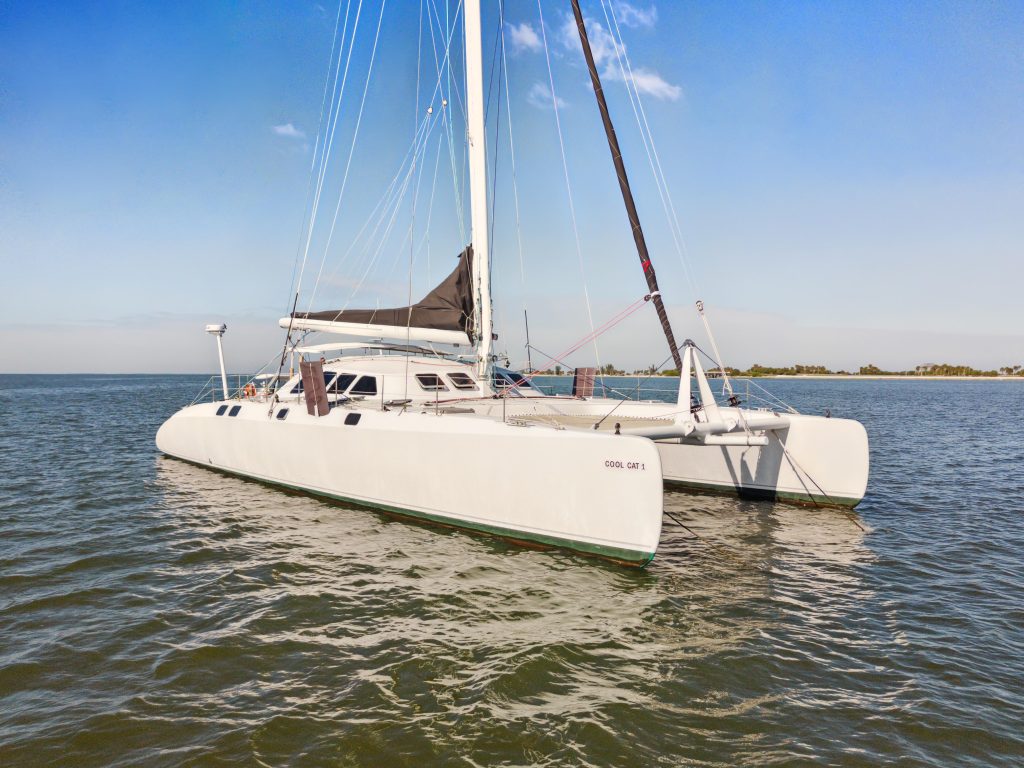
Cool Cat was built by the Techno yard in Brazil, best known for the Dolphin catamarans, and is hull number three of a series of six sisterships, launched in 2000. Construction is carbon epoxy throughout. The centerpiece is a rotating carbon wing mast — cured in an oven — with all-textile standing rigging replaced in 2016 and a carbon fiber Park Avenue boom. The sail inventory is recent Calvert Sails: a carbon composite mainsail, carbon composite self-tacking jib, a 2022 gennaker and two spinnakers.
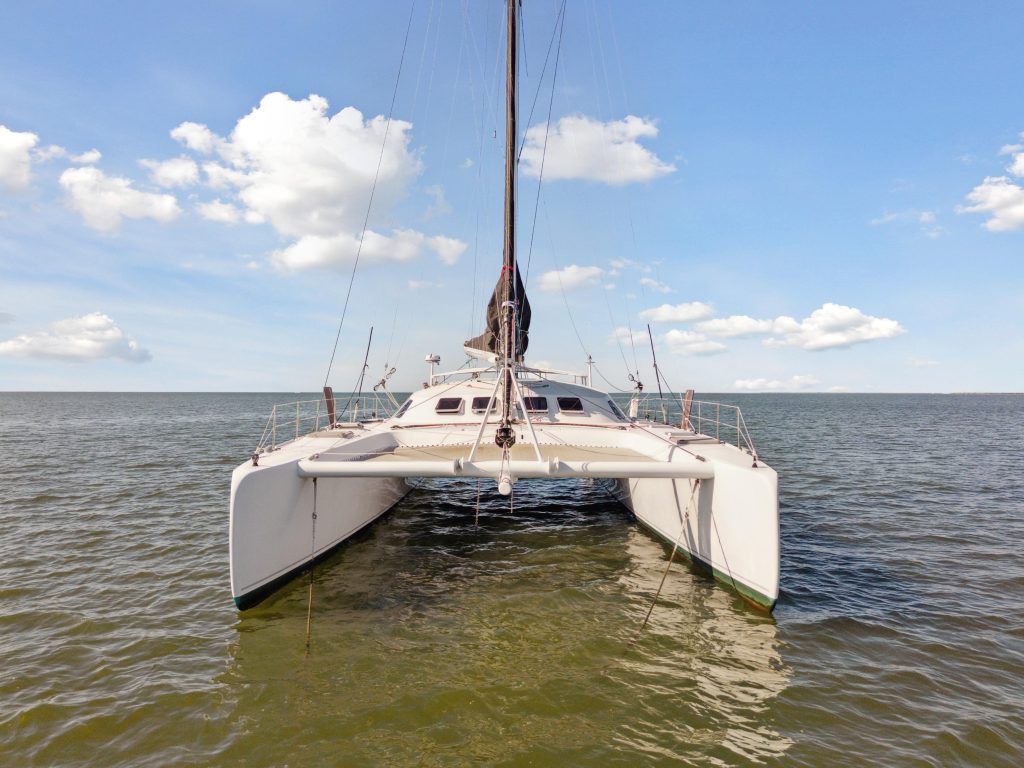
Walk forward along the wide decks and you pass outboard carbon composite daggerboards, long narrow hulls and a big trampoline. The distinguishing feature, as the video explains, is the limited bridgedeck footprint relative to waterline length. All-up weight is just under 20,000 pounds. Long legs and minimal deck volume give a sea-kindly motion in chop and rough water, allowing high averages while other boats hobby-horse.
Interior: honest and uncluttered
A wide sliding doorway leads to the main saloon — no frills, no liners hiding mold, no unnecessary embellishment. A dining table seating five to six dominates to port with a wrap-around Ultraleather settee; a large forward-facing chart table doubling as a desk sits to starboard, with Raymarine autopilot, Standard Horizon VHF, AIS and Fusion stereo. The galley is down to port with large countertops, a three-burner stove and oven, updated fridge and freezer, and ample storage, plus an additional fridge/freezer in the saloon. Forward cabins have double berths and good natural light from topsides portholes; the large aft cabins offer impressive headroom and queen-size beds. Each hull has a head with shower.
Systems
Twin Yanmar 54 hp engines are set forward in watertight transom compartments, with two new SD60 saildrives and new Flexofold three-blade props installed in July 2022. A Yanmar generator with 250-amp DC alternator lives in the port engine space, alongside a clutch-driven watermaker rated at 60 gallons per hour.
The summary from the video is refreshingly plain: a superbly constructed, simple performance cat with beautiful lines, designed for 200- to 300-mile days and proven over many ocean passages. For context, custom yachts listed on the site currently ask between $30,000 and $1,400,000, with a median asking price of $282,500.
| Custom market (site figures) | |
|---|---|
| Sold, last 24 months | 33 |
| Median sold price | $80,000 |
| Median days to sell | ~121 |
| Active listings | 24 |
| Asking range | $30,000–$1,400,000 |
| Median asking | $282,500 |
Alexis de Boucaud invites interested buyers to view Cool Cat in person in Sarasota.