
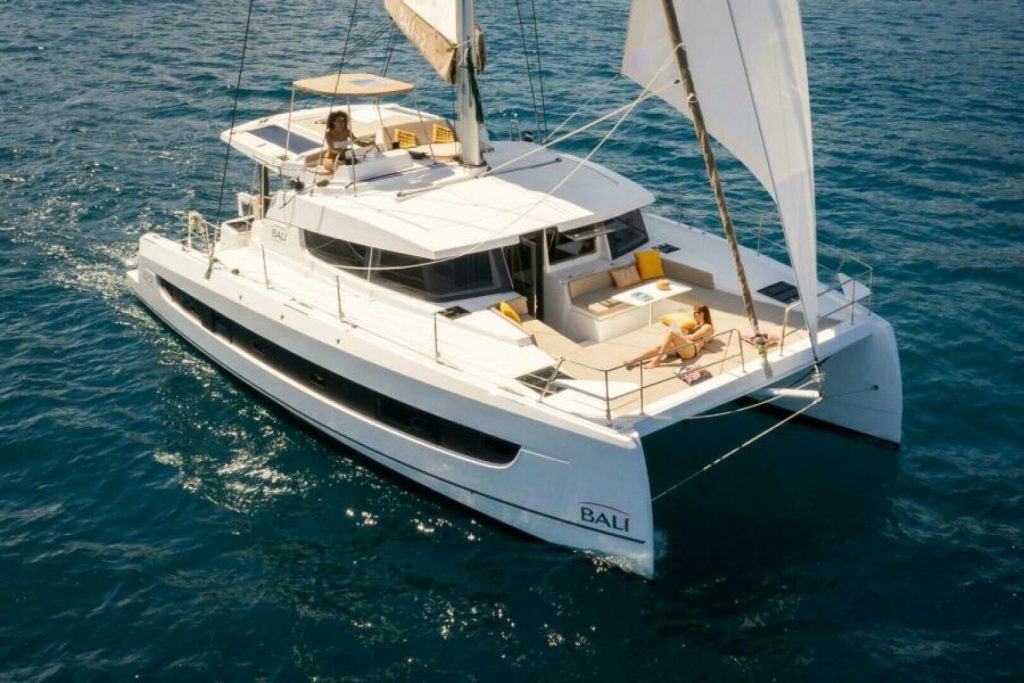
Two years of teaching, one Atlantic passage and a 13.5-knot top speed — an instructor's candid tour of what the Bali 4.2 does well, and how to sail it properly.

Most boat tours are led by someone who has owned a yacht. This one is led by someone who has taught on one — every week, in every kind of breeze Florida can serve up. In the walkthrough video presented with Eric Macklin’s listing for the Bali 4.2 S/V Clover, instructor Steele Greyling talks through two years of full-time sailing school use, from light-air trim tricks to where the anchor chain goes. It is one of the more useful catamaran videos out there, because so much of it is about technique rather than brochure copy.
How the Bali 4.2 actually sails
The first question buyers ask about Bali, Greyling notes, is performance. His answer is refreshingly specific. The 4.2 has a small forward triangle, so with a full mainsail up the boat wants to round up, and the self-tacking jib isn’t large enough to counter it — leaving you dragging 12 to 15 degrees of rudder angle and scrubbing off speed. His fix runs against instinct: reef early. In as little as 8 knots of breeze he’d take the first reef, keeping the boom high so the sail spills a little air while staying full. By 12 knots the jib is doing enough work that the full main behaves.
Does it keep up? Sailing alongside other boats regularly, he reckons the 4.2 out-sailed roughly 80% of similar-sized monohulls, and that against catamarans of comparable size it came down to who trimmed better. The headline number: 13.5 knots on a northerly breeze with a beam swell, running the Code Zero on a passage from Florida to Bermuda.
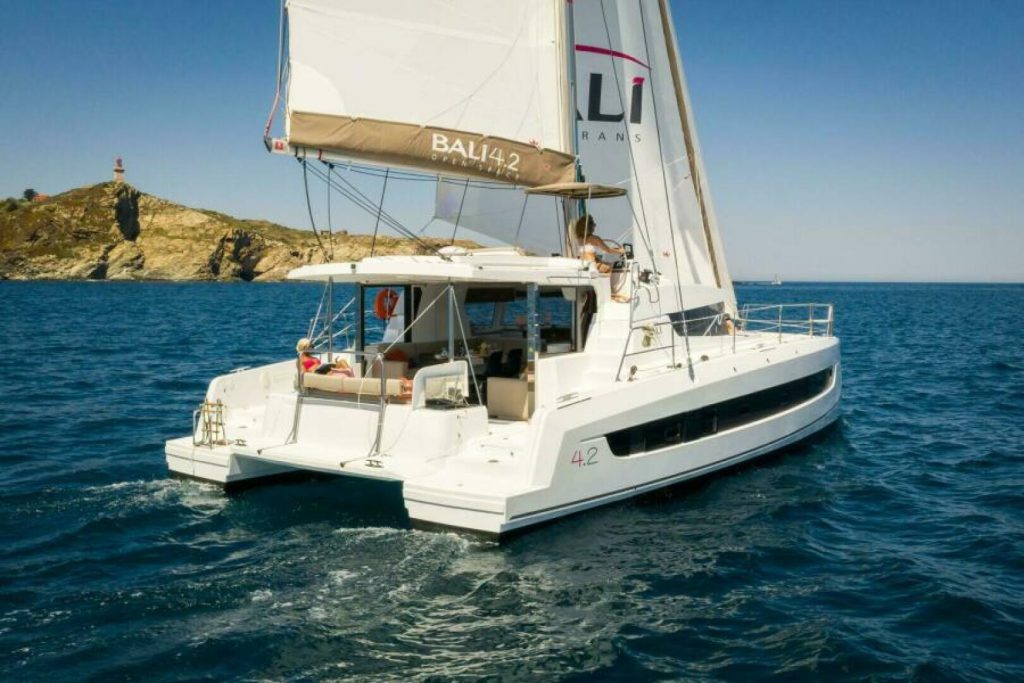
That Code Zero gets a good segment. Because the Bali 4.2’s rig has no spreaders, there’s nothing for the sail to foul on, so it can be sheeted very tight — Greyling has carried it as close as 60 degrees apparent, and uses it through to 180. He keeps it inside about 18 knots apparent; that’s a lot of area for a 42-footer. It’s a furling sail on a sprit, with the furling line led aft to the cockpit, and a clutch on the tack line so you can bring the drum inboard to work on it rather than crawling out on the sprit.
Tacking a self-tacker
A recurring complaint about self-tacking jibs is getting the bow through the eye of the wind. Greyling’s method: sheet the jib in tight before you commit, ease the mainsheet so the main isn’t fighting the turn, then put the wheel hard over quickly and don’t start bringing it back until you’ve passed 60 degrees on the new side. Under engine, he says, maneuvering is simply easy — and the boat tacks single-handed without drama.
On deck
The forward cockpit and solid foredeck are the Bali signatures, and the video treats the usual objections head-on. Seating for six at a table, a set of speakers, and — in his experience — a completely dry space under sail unless you’re bashing into big waves. It became his primary dinner table at anchor and underway. Drainage is handled by two small holes at the bow plus a large drain outside the front door and under the anchor locker hatch; even with water coming over the bow in a seaway, he says he never saw it pool. His summary of the hard foredeck is honest: people knock it before they try it, then after a week aboard they understand.
The other Bali trademark, the tilting garage-style aft door, gets used daily. In chop he’d keep it closed; inside a bay or between close islands, it never shuts. Elsewhere the deck is flush and hatch-free, with a high bow rail, big grabrails and gently sloped steps to the flybridge — the sort of details that matter when you’re teaching newcomers to move around a boat. The anchor windlass can be controlled from the locker forward or from the helm, and the locker opening gives enough visibility to anchor confidently despite the absence of trampolines.
At the helm, everything leads aft: sheets, reef lines and halyards all terminate within reach, with an electric winch to port for halyards and manual winches on starboard and outboard port. There’s a large chart plotter, autopilot control, engine panels, windlass control, compass, throttles and a handheld VHF tucked to the side. Above the helm seat is what Greyling calls the best sun deck on the boat.
Systems and accommodation
Power comes from twin Yanmar 4JH 45 hp diesels, which he trusts and describes as burning just shy of a gallon an hour per engine at 2,000–2,200 rpm. Engine access is genuinely standing-room, with a 12-volt watermaker producing around 30 gallons an hour without running the generator, plus easy reach to the steering cable, Raymarine autopilot control and ram.
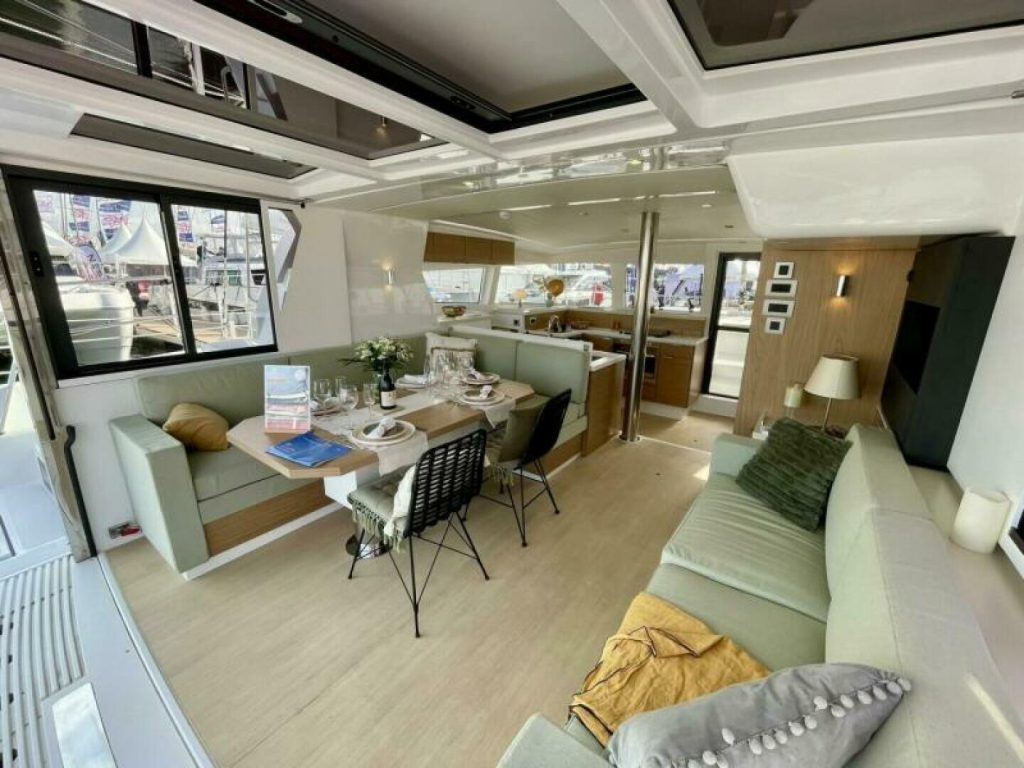
Inside, the nav station carries the Raymarine system, VHF and switching, and the generator and watermaker can be started from there. A door leads forward to the foredeck for cross-ventilation with the forward-opening window. The galley has a three-burner propane stove with oven, generous cabinetry, two pantries below and a large, lockable fridge-freezer. The saloon table drops on removable legs with an infill cushion to make an additional berth, and there’s storage under every seat. A pass-through hatch links saloon and cockpit.
The layout is three cabins, three heads. The owner’s suite is spacious with a semi walk-around berth, seating, a desk and a head with twin basins plus a separate toilet and shower. Down in the starboard hull, the forward and aft cabins each have queen berths and their own en suite with shower and toilet.
Where the model sits
For context on the wider Bali 4.2 market, YachtSite’s own figures are below.
| Metric | Figure |
|---|---|
| Sold, last 24 months | 5 |
| Median sold price | $600,000 |
| Median days to sell | ~261 |
| Active listings | 3 |
| Asking range | $415,000 – $834,525 |
| Median asking | $449,000 |
| Median sold (24 mo) | $600,000 | |||
| Median asking | $449,000 | |||
| Lowest asking | $415,000 | |||
| Highest asking | $834,525 |
What makes this video worth the time is that it’s less a sales pitch than a handover briefing: reef early, keep the main loose through the tack, watch the apparent wind under the Code Zero, and leave the back door open. Buyers considering the model will come away knowing what they’re getting into.