
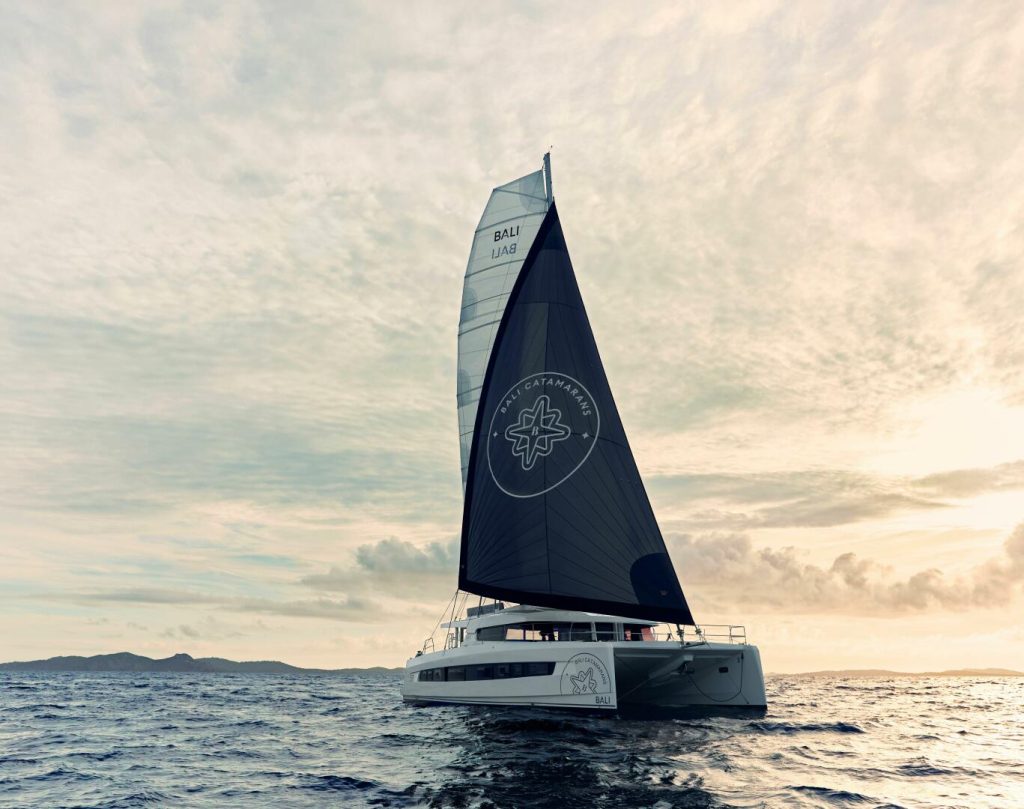
From a chef-grade galley to a 20-person rooftop, the largest Bali yet was toured in Canet with a guest whose opinion the yard actually cares about.

There is a moment early in the walkthrough of the Bali 5.8 when the host, standing in the yard’s home waters in the south of France near the Spanish border, quietly rattles off the numbers: 17 metres long, 9.06 metres of beam, and only 25 tonnes. His guest, Sam — a serial catamaran tester and, by the host’s own admission, a good friend whose judgement matters — had already said it without the data: “there’s a really nice feeling of space.”
That exchange is the whole video in miniature. The Bali 5.8 is the biggest catamaran the builder has launched, and bigger still if you count the hydraulic aft platform and the bowsprit. But the tour spends far less time on superlatives than on how the boat is actually lived in — which is appropriate, because the host cooks a full Catalan meal on board while explaining it.
A galley designed for someone who cooks
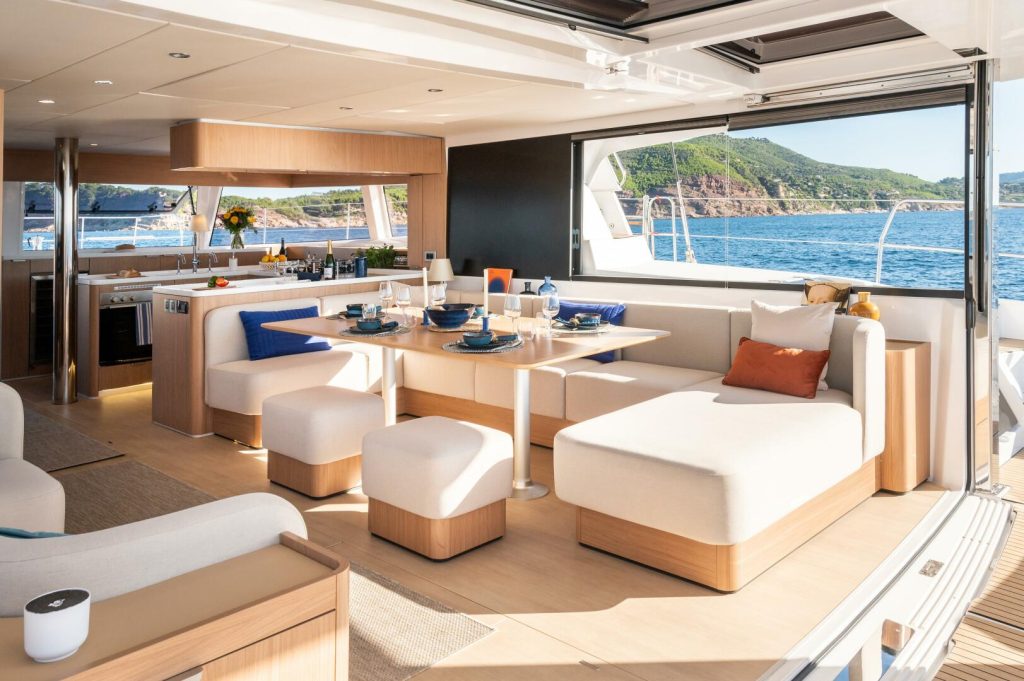
The tour opens, unusually, in the kitchen. Back from the fresh market with local peppers, onions from Toulouges, garlic, shallots, chorizo and prawns, the host makes his case: the galley on the 5.8 got disproportionate design attention, and it shows. Deep drawers for big pots, dedicated spice storage, a dishwasher, oven, a double sink, a bin, and a substantial stove sit amidships — connected to the forward cockpit on one side and the guest dining table on the other. Sam notes that the cook is nicely enclosed with everything to hand; the host adds the practical point that you can brace yourself in a seaway.
The reasoning behind it is commercial as much as culinary. The 5.8 is aimed at private owners and at charter, and on a boat this size there will almost always be crew aboard. “If you don’t offer a nice galley to a chef, you won’t have the proper one,” the host says. The same logic explains the enlarged crew cabin — keep the captain and chef comfortable and they stay.
Layouts: three to six cabins
The 5.8 is offered in three, four, five or six-cabin configurations, plus crew quarters. The boat filmed is a 3+1: three cabins plus a full owner’s suite.
The forward guest cabin has a queen berth facing the sea, wardrobe and under-berth stowage, cupboards, its own shower and head, and an optional access hatch through to the forepeak. A midships cabin is pitched at kids or friends, with a private shower and a separate dry head, and can be specified as an island queen. The aft cabin is the interesting one: it opens only from the deck, with no internal access, so it works equally as a very private guest suite or as crew accommodation with direct access to the working end of the boat. It too gets a queen berth facing the water, generous wardrobes and drawers, a dry head and a separate shower.
Then there is the owner’s hull — the host’s word, and the right one. A king-size bed you can walk entirely around, facing the sea, full-length mirror, wardrobes and drawers seemingly everywhere, and a desk area that can be specified as a second office or a vanity. Forward is a small basin and a toilet compartment separated from the bathroom itself, with a direct exit onto the deck for a pre-breakfast swim. The bathroom aft has a double sink, storage, and a shower big enough for two with daylight and a view out. Sam’s verdict — “it’s bigger than most bedrooms at home” — is followed by a remark about how silent it is down there.
The chart table that runs the boat
Perhaps the most genuinely new thing in the video is at the old-school chart table, which doubles as an office. Alongside the chart plotter, autopilot, VHF and the controls for the water maker and generator sits a touchscreen running an in-house electricity and fluid management system developed specifically for the 5.8, and destined to roll out across the rest of the range.
The stated aim was simplicity — “idiot-proof,” as the host puts it — with room to add sensors later. From one screen you see battery state of charge, live current draw, solar production (modest on a cloudy morning), and tank levels for fresh water, black water and diesel. You can also switch circuits on and off: all cabin lighting, ambience lighting and courtesy lights can be killed with a single tap. There is even a recipes page, which the host defends as the most important feature on a French boat.
Engine room, power and the mechanical side
Two people stand comfortably in the engine room, which the host argues is non-negotiable on a boat meant to cross oceans — changing filters in a cupboard is nobody’s idea of maintenance. Inside: the hydraulic pump for the aft platform, a large boiler in each hull, an extinguisher, and a 240-litre-per-hour water maker — around 55 to 60 gallons an hour depending on sea temperature, which matters with twelve people aboard.
Propulsion is by Nanni. The boat shown carries 110 horsepower; standard is 80, with 135 also available. The host’s point is not top speed but ease: around nine knots at under 2,000 rpm, quiet and economical, with the hull shape doing much of the work.
| Standard | 80 | |||
| Fitted to boat shown | 110 | |||
| Maximum option | 135 |
A 17.5 kW generator lives in its own well-insulated locker up forward, sited for noise isolation and easy access to filters and impellers.
The tilting door and the solid foredeck
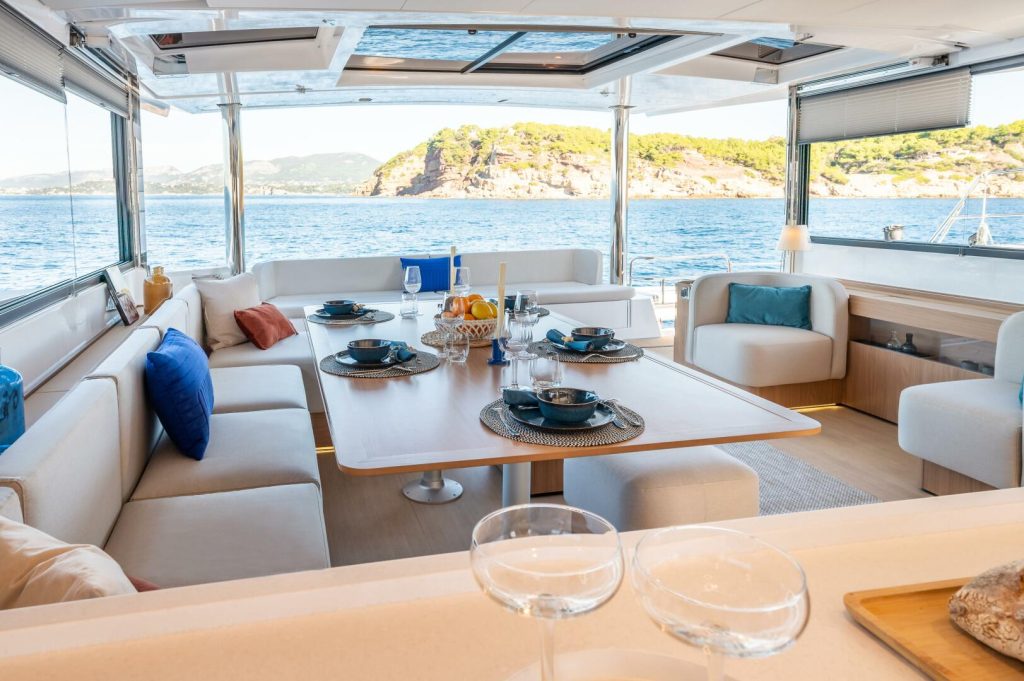
Two signatures define the Bali layout, and both get proper airtime. The tilting aft door — hydraulic, operated by a single button, with two gas springs — opens the saloon to the aft cockpit entirely, or closes to keep the full interior volume when the weather turns. It turned during filming, incidentally, going distinctly English with a Pyrenean thunderstorm; the pair simply sat at the coffee lounge, dry, and carried on. With the door up, the boat becomes one continuous tunnel of ventilation from stern to bow.
Forward, the solid foredeck replaces the trampoline with a structural beam, sunbeds and a dining table. The host argues it adds stiffness and forward buoyancy so the boat doesn’t pitch, and notes that slamming happens under the bridgedeck rather than here. Beneath the cushions are the anchor locker and windlass, plus an enormous gel-coated locker that swallowed seven fenders and a pile of lines on camera.
Living aft and above
The saloon lounge hides a sliding-out TV and concealed air-conditioning outlets, seats around twelve at the table, and sits above full-length under-floor dry storage that runs the length of the boat — mostly empty, and intended for provisioning boxes. The aft cockpit lockers hold the life raft, fenders, lines and space for toys, paddleboards and diving gear.
At the transom there is a barbecue mounted outside the living area so smoke stays out of it, a spare gas bottle locker, a home for barbecue utensils, a swim ladder with a settee to dry off on before stepping into the cockpit, a deck shower, and the gas locker feeding both barbecue and galley stove. The hydraulic platform can be dropped below water level for dinghy work or for children to swim from safely, then slides back up onto the boat. Side gates with a deployable boarding ladder — usable on either side — handle Mediterranean alongside berthing.
The flybridge is described, fairly, as a rooftop: enlarged over the 5.4, with three zones. Aft is a sunbathing area created by folding the lounge backrest; the lounge itself seats around twenty for cocktails, with a fridge for beer and big lockers under the seats. Dining stays downstairs, deliberately. At the helm, a four-person seat converts to a bolster, engine controls and displays — chart plotter, anchor readout, radio, bow thruster — sit under a hardtop, and the winches and working gear are kept forward so they never intrude on the guest area. A small wet bar with fresh water and glass storage completes it.
Where the model sits
| Active Bali 5.8 listings | 1 |
|---|---|
| Asking price | $1,458,000 |
| Length | 58 ft |
| Year | 2026 |
S/V Bali 5.8 is listed by broker Eric Macklin. It is the only Bali 5.8 currently active on YachtSite, asking $1,458,000 — a rare chance to look at a brand-new flagship rather than wait for one.