
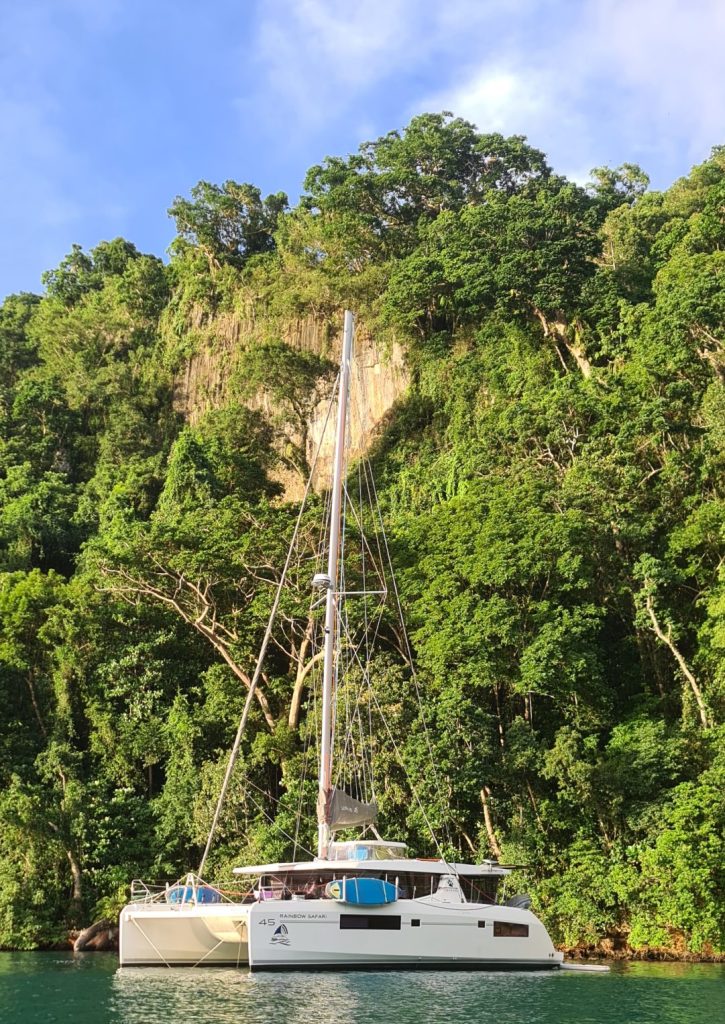
Seven years, six family members and a Singapore-to-French-Polynesia wake — owner Stefan walks you through the catamaran that raised his kids.
Some boat tours are staged. This one isn’t. Stefan filmed his own self-guided walkthrough of S/V Rainbow Safari, a 2018 Leopard 45, from the helm seat of a boat he bought new and has lived on with his family for the last seven years — and the result is less a sales pitch than an honest handover briefing from one cruiser to the next.
The history is worth stating up front, because it shapes everything else in the video. Rainbow Safari was delivered in April 2018 to Singapore, where the family was living at the time. From there came roughly three years of cruising Southeast Asia, a Covid interlude tied to the dock in Singapore doing duty as a floating home office, then a long push east — all the way to Fiji, the South Pacific, the Tuamotus and French Polynesia, and back again. Total logged: somewhere around 22,000 to 24,000 miles. Six people aboard, with the youngest just two and a half when they moved on and now ten, and the eldest eighteen.
Stefan is candid about why they’re selling: family closer to home and school for growing kids, not dissatisfaction. “We’re kind of in two hearts about it,” he says, “because we’re quite happy and there’s still a lot to explore and discover on the boat.”
Living upstairs, not in the basement
The first thing he points out is the wraparound glass. The saloon’s 360-degree windows mean, as he puts it, that you don’t live “in the basement” — when you’re anchored off a beach, the bay is simply around you all the time. The split-level helm is the other design decision he clearly rates: three steps up from the saloon, with courtesy lighting on the stairs, so the person driving stays connected to the cockpit, the saloon and, crucially with young children aboard, the kids.
The helm station is enclosed in clears — a set the family had made — which roll up or come off entirely, preserving the view while cutting glare and rain. Electronics are Raymarine: touchscreen plotter (still loaded with routes and waypoints for Southeast Asia and the Pacific), autopilot, wind/speed/depth instrument, radio, engine controls and a compass that Stefan admits “isn’t getting much use these days, but it’s there.” There’s also a Raymarine remote that lets you drive from the deck.
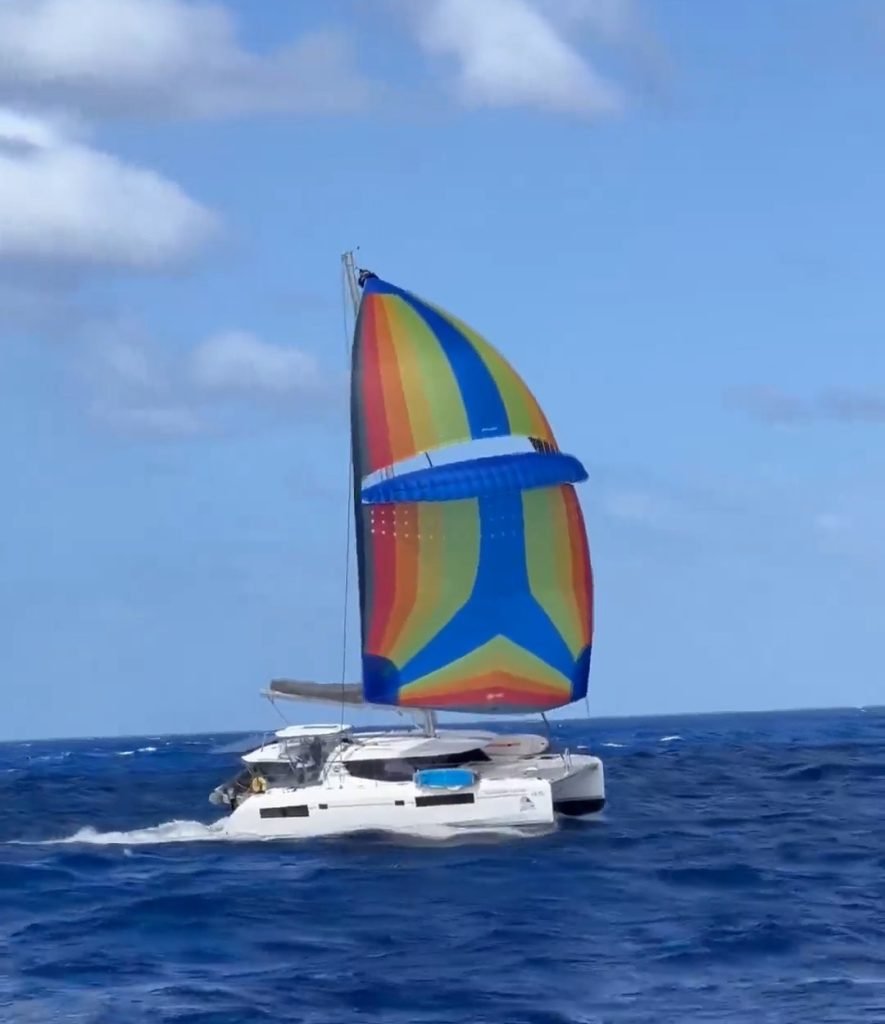
All lines lead to the helm, so the boat is genuinely set up for single-handing, with two electric primary winches operated by foot buttons and a locker for line tails. Stefan’s one caveat is practical rather than critical: for reefing and for dropping the main fully, he prefers one person at the mast and one working the lines. “In a pinch it can go without a person at the mast, but it’s easier.” The mainsheet runs on a bridle system with its own dedicated winch and two jammers — a setup he says gives good control over sail shape. Also led aft: the genoa furler, main halyard, and sheets and spinnaker halyard for the Parasailor.
Power, water and the practicalities of six people
This is where the video earns its keep for anyone pricing out a liveaboard cat. Above the cockpit sit four panels totalling 1,440 watts, wired two-and-two in parallel, supplementing the factory-installed 4 x 100 W soft panels for 1,840 watts of solar in total. Stefan breaks the consumption down roughly into thirds: watermaking, refrigeration and cooling, and everything else. A diesel generator, sitting under a cover forward and drawing from the port tank, covers short or cloudy days. Electrical hardware is Victron — Color Control, battery monitor, MPPTs and a MultiPlus 3000 W inverter — with the DC and AC panels, BlueSea AC panel, alarms, generator start and air-conditioning controls all grouped neatly behind a door in the saloon.
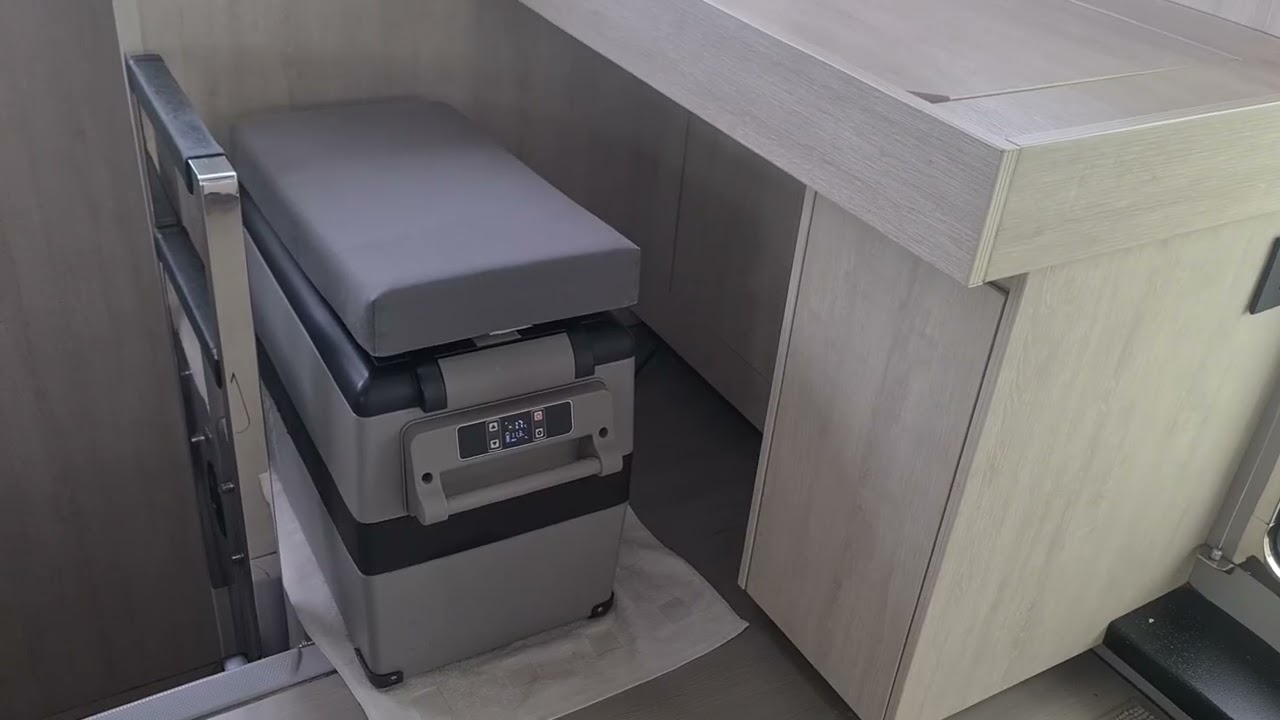
The watermaker is a German-made Aquatec unit, which he reports has run well. Refrigeration runs to three units: the main fridge with in-and-out fridge and freezer drawers, a proper small fridge in the cockpit, and a cooler box doubling as the nav desk seat that can be dialled anywhere from freezing (“right now it’s at minus 7”) to 12 degrees for fruit and vegetables.
The galley has been upgraded from the standard gas oven to a Gas Bus Ocean Chef — “we’re German, we like good bread” — alongside a three-burner hob, microwave/grill oven, coffee maker, Instant Pot, kettle and toaster, all of which stay with the boat. House rule aboard: only one heavy-draw appliance at a time.
Cockpits fore and aft
The aft cockpit is the real living room. It’s enclosed with mosquito mesh plus outer clears that roll up, and the table seats eight comfortably; with other boats visiting, Stefan reckons they’ve had more than twelve people around it, and with kids running fore and aft, as many as 25 aboard at once. Big sliding doors connect it to the saloon, which in turn opens forward to the Leopard’s signature forward cockpit — a feature he says they fell in love with less for the seating (though there are bean bags staying aboard and a sliding roof hatch) than for the ability to reach the trampoline and foredeck directly from inside without sending children around the side decks.
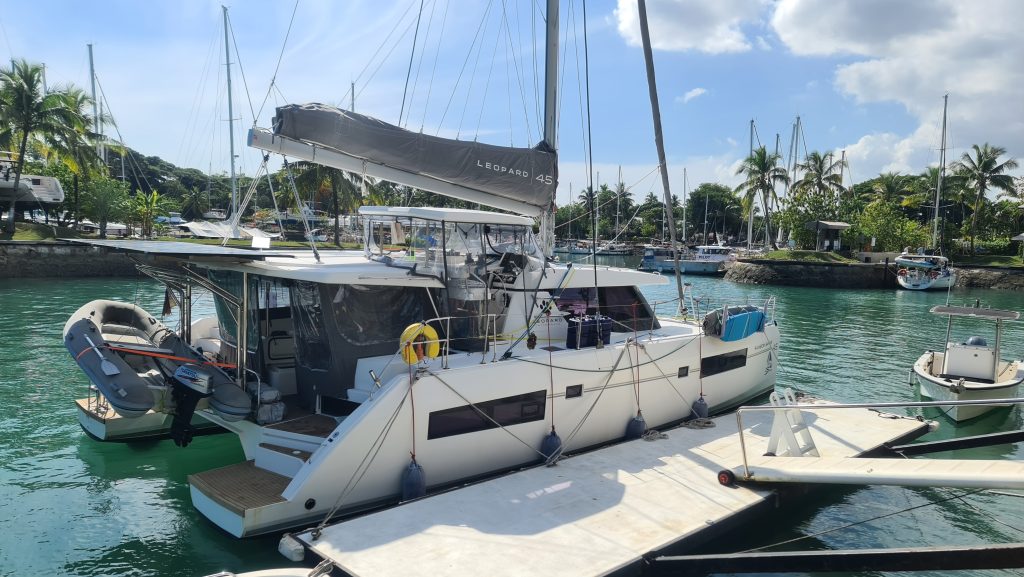
The Highfield Classic 380 tender sits on the standard Leopard davit arrangement: an electric winch and a bar system operated by a ceiling button, lowering the dinghy in a couple of minutes with, in his words, “zero effort.” Chaps were fitted early in Thailand, so the Hypalon is in good shape; the outboard is described honestly as dated but running well after an overhaul this year.
Accommodation: owners one side, kids the other
The starboard hull is the full owner’s suite — queen-sized berth with a corner cut off for easier access, ceiling fan, upgraded reading lights, drawers under the bed and in the hull side, bilge floor hatches, a large closet (convertible to hanging by removing shelves), vanity seating and the deep bookshelves Stefan singles out as a Leopard strength. The head is, as he says, “a bathroom, not a head” — separate shower, daylight hatch, and a cabinet housing a full-size 8 kg household washing machine (no dryer; never needed one).
Port is the kids’ hull: aft and forward cabins, both en suite with closing doors, mirror-image queen berths, fans, air conditioning behind the wall panels, and the forepeak cabin which their youngest claimed as her “pirate’s nest” — closable, and per the designers usable as crew or utility space. The starboard forepeak is a very deep locker, fitted out with shelves so it isn’t “just a big hole to fall into”; the port forward lockers hold water tanks, a kayak, the Parasailor, and a Bauer Junior dive compressor with four tanks.
Stefan is refreshingly frank about wear: the saloon vinyl “probably needs a refresh,” and the bathroom mirrors show the spotting familiar to anyone who’s kept a boat in the tropics. Otherwise, he argues the boat doesn’t read as one that housed six people for seven years — and notes it’s been kept salt-free inside the whole time, with a foot-rinse bucket at the sugar-scoop shower and swim ladder.
How she sails
Twin Yanmar 45 hp engines, accessed from the aft bays, have needed little beyond regular oil changes and one set of starter batteries, with around 2,500 hours — a reflection of long equatorial passages and a lot of easting. Extras in the bays include a fuel transfer pump between tanks, underwater blue lights, and a smart relay that can link house to engine batteries from the helm, jumper-cable style, while preventing the house loads from flattening the start banks.
Under sail, Stefan logs about 6 knots as a typical cruising average, with 9–10-knot days when the wind cooperates and a top logged speed of about 14 knots — “faster than we really wanted to go at the time.” Sailing angles: roughly 45 to 50 degrees under sail alone, tightening to nearer 30–32 degrees with one engine running and the autopilot on wind vane. The Parasailor opens up everything from about 90 degrees aft in 5 to 20 knots. The sails are seven years old with no tears or weak spots, and he estimates at least two more years of use for a cruiser, more replacement-minded if you want to sail sportily.
Where she sits in the market
For context, the Leopard 45 has been trading steadily on YachtSite, and buyer interest has picked up noticeably in the last month.
| Metric | Figure |
|---|---|
| Leopard 45s sold (last 24 months) | 10 |
| Median sold price | $674,500 |
| Median time to sell | ~196 days |
| Active listings now | 4 |
| Active asking range | $390,000 – $759,000 (median $612,000) |
| Inquiries, last 30 days | 8 (vs 3 prior 30 days) |
| Median sold (24 mo) | $674,500 | |||
| Median asking (active) | $612,000 | |||
| Lowest asking | $390,000 | |||
| Highest asking | $759,000 |
What comes across most clearly in the tour is that this is a boat configured by people who actually went cruising — enclosures made to suit the tropics, solar sized to a family of six, dive and watersports gear stowed where it belongs, and a galley built around feeding everyone. Stefan closes by offering to talk boats at length with anyone interested, which, after 40 minutes of unvarnished detail, feels entirely in character.